


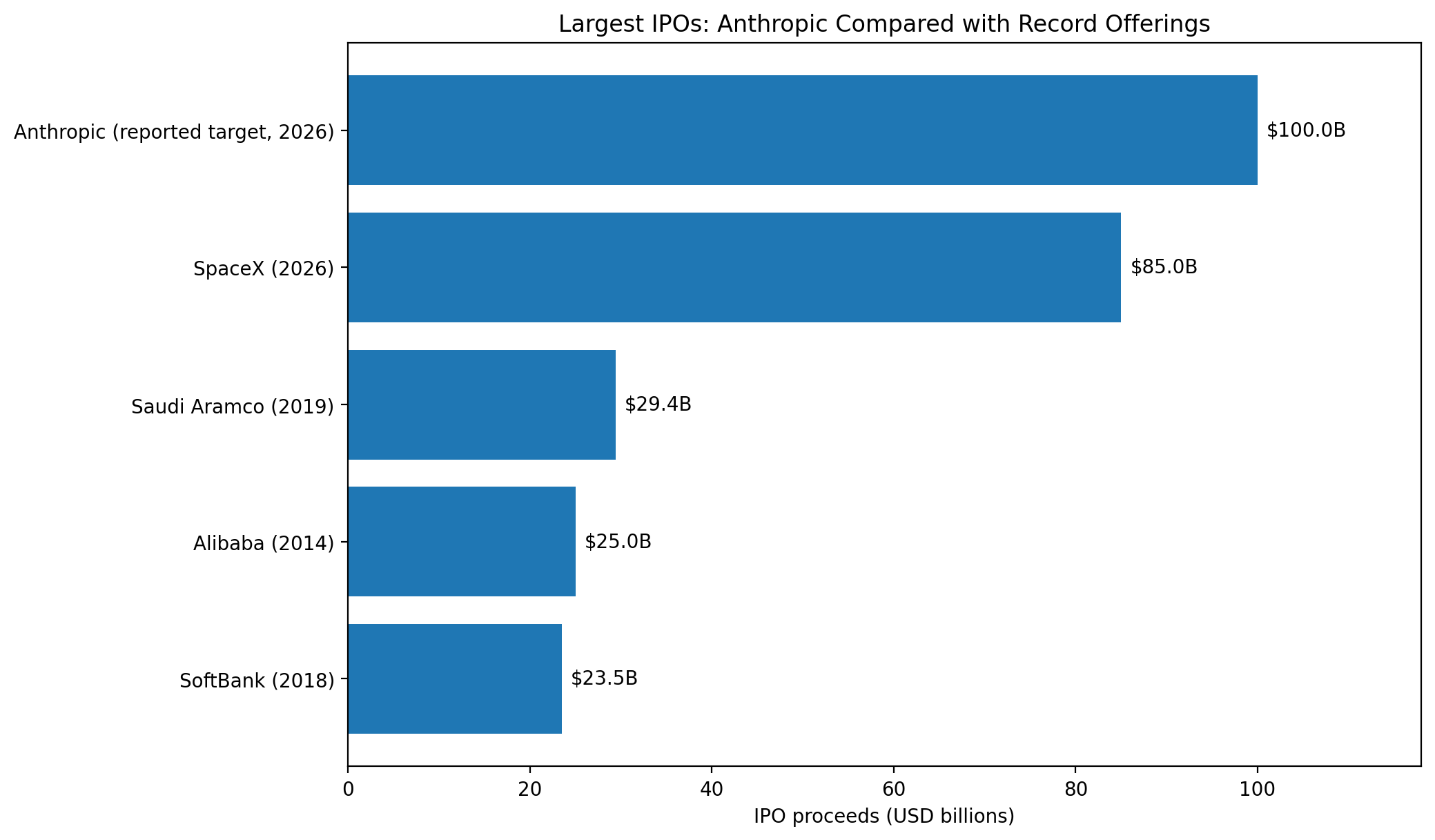
Anthropic is preparing to go public in what could be one of the most closely watched IPOs in history. It is reportedly aiming to raise as much as $100 billion at a staggering $2 trillion valuation, potentially surpassing SpaceX’s record-setting June IPO, which ultimately raised more than $85 billion and valued the company at approximately $1.77 trillion.
But for corporate governance observers, the offering’s most compelling question may be who will control the company, rather than its valuation, revenue growth, losses, or competition with OpenAI.
Anthropic’s seven cofounders would collectively control 50.1% of the voting power on key shareholder matters through a newly created Founder LLC and a special Class F share, according to Reuters’ review of the company’s IPO prospectus. Their economic ownership is considerably smaller. The Information reports that Dario Amodei owns roughly 2% of the company, a comparatively small percentage stake for a founder-CEO taking a company public, though worth approximately $40 billion at a $2 trillion valuation. Amodei said on a podcast last year that all seven cofounders, including his sister, Anthropic President and Board Chair Daniela Amodei, hold roughly equal stakes.
Founder control after an IPO is nothing new in Silicon Valley. What distinguishes Anthropic is that it would layer control shared among seven cofounders onto two existing mechanisms designed to protect its mission: its public benefit corporation (“PBC”) structure1 and the Long-Term Benefit Trust2, which has the power to elect and remove directors.
So the structure is not simply founder control. It is founder control, a public benefit corporation, and an independent trust, all operating at the same time.
Anthropic was already a governance experiment
Its public benefit purpose is the “responsible development and maintenance of advanced AI for the long-term benefit of humanity.” As a Delaware PBC, the board can balance stockholder interests against that public benefit and the interests of those materially affected by the company’s conduct.
But Anthropic decided that the PBC structure did not go far enough. The company’s concern was that giving directors legal authority to consider a public purpose is different from creating accountability around that purpose. Its response was the Long-Term Benefit Trust.
The Trust was designed as an independent body of five trustees with expertise in AI safety, national security, public policy, and social enterprise, and relatively little financial interest in Anthropic. Under the original design, its Class T stock would give it the power to elect and remove an increasing number of directors, with a board majority assured within four years. Anthropic described the arrangement at its inception as a “corporate governance experiment.”
Adding founder control
The Founder LLC would add concentrated voting power to Anthropic’s existing PBC structure and Long-Term Benefit Trust. The question is how these three mechanisms will interact, particularly when founder priorities and independent judgments about the company’s mission diverge.
The Founder LLC also includes rules governing how control is exercised, removal provisions, and a sunset mechanism that becomes relevant when only two founders or their successors remain.
For Anthropic, the logic is particularly significant. The company is effectively telling investors that advanced AI could create enormous economic value while also posing potentially catastrophic risks. There is therefore a reasonable case for a governance structure that allows the company to resist financial pressure when management and the board believe safety or its public benefit purpose requires it.
The harder question is how this balance will work in practice when the founders, trustees, board, and public shareholders do not all want the same thing.
The board matters
A recent analysis by Marco Mari on Columbia Law School’s Blue Sky Blog highlights why the issue is important. The Long-Term Benefit Trust would elect four directors, while Class A and Class F stockholders would elect the remaining three. Because of the voting power attached to Founder LLC, the founders and the Trust could effectively determine the composition of the entire board.
If that is the structure that ultimately appears in the public filing, public stockholders may not have the ability to elect a single director independently. That takes us beyond the familiar debate over dual-class stock.
Mission protection and founder entrenchment
Concentrated founder control can protect a company from short-term market pressure. It can give management room to pursue a long-term strategy and resist demands that conflict with the company’s mission. It can also insulate founders from legitimate concerns about performance, strategy, leadership, or risk.
The same tension exists with the Trust. An independent body can protect Anthropic’s mission from commercial pressure, but it can also create another layer of authority that is difficult for outside shareholders to influence.
Every governance structure allocates power somewhere. What is distinctive about Anthropic is how deliberately it is dividing that power between founders and trustees.
Who holds the founders and trustees accountable?
What happens if the founders and trustees disagree about the release of a new model? Who decides whether a particular decision advances Anthropic’s stated public benefit? What happens if performance deteriorates and shareholders believe management failure is being defended as mission protection?
And what happens if either the founders or trustees themselves become the governance problem?
And how would this balance change if the U.S. government became a shareholder, a possibility President Trump has left open for Anthropic? Proposals across the industry range from a reported 5% stake in OpenAI to Senator Sanders’ proposed 50% public ownership of major AI companies. Depending on the voting rights and board representation attached to any stake, government ownership could significantly alter the balance of power among founders, trustees, and public investors.
Frontier AI is testing the corporate governance model
Anthropic is not alone in concluding that conventional corporate governance may be insufficient for frontier AI. OpenAI has taken a different path, with nonprofit control over a public benefit corporation, although it didn’t start that way.
The mechanisms differ, but both companies start from an important premise: there may be decisions involving frontier AI that should not ultimately be determined by the economic interests of stockholders.
Public stockholders would not be without legal recourse. They could still bring derivative, class, and federal securities claims where appropriate. Delaware’s PBC statute does, however, impose a special standing requirement for actions seeking to enforce the directors’ statutory balancing obligation. For a listed company like Anthropic, stockholders bringing such a claim would need to collectively own at least $2 million of the company’s shares. At a potential $2 trillion valuation, the alternative 2% threshold would amount to roughly $40 billion.
Anthropic may have designed a structure that allows it to preserve its mission while raising enormous amounts of capital and operating as a public company. Or it may have created a system in which a small number of founders and trustees exercise substantial power while public stockholders have limited influence over who ultimately governs the company.
We will know more when the company publicly files its S-1.
Boardroom Governance Podcast 🎙️
My latest episodes are listed below and are now available in both video and audio. Watch on the new Boardroom Governance YouTube channel, or listen on Apple Podcasts, Spotify, or Simplecast.
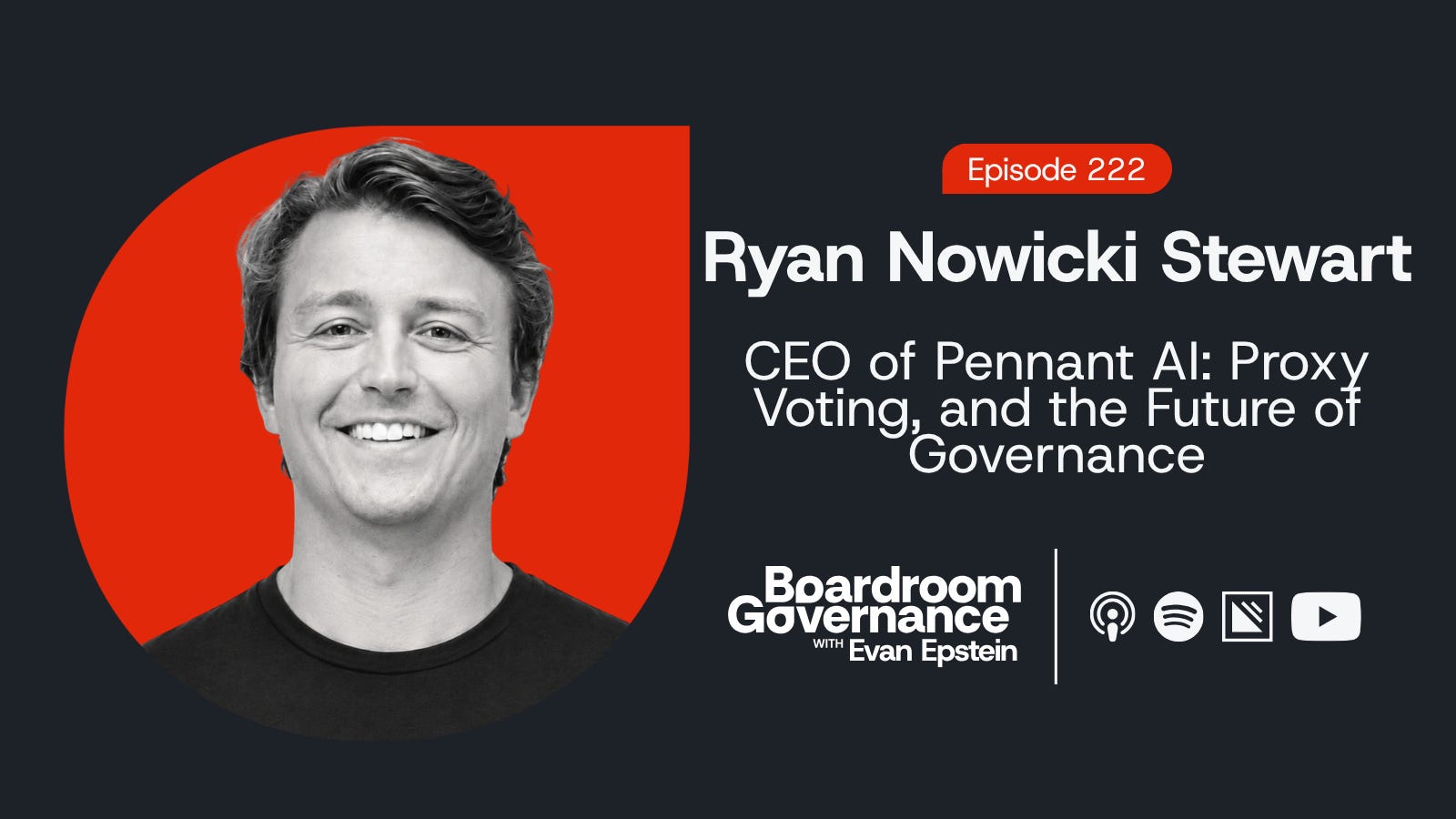
E222 Ryan Nowicki Stewart: AI, Proxy Voting, and the Future of Governance. Ryan Nowicki Stewart is the co-founder and CEO of Pennant AI, and in this episode we discussed how AI is changing proxy voting and institutional investor stewardship. We also discussed proxy advisors, going through Y Combinator, and the convergence of public and private markets.
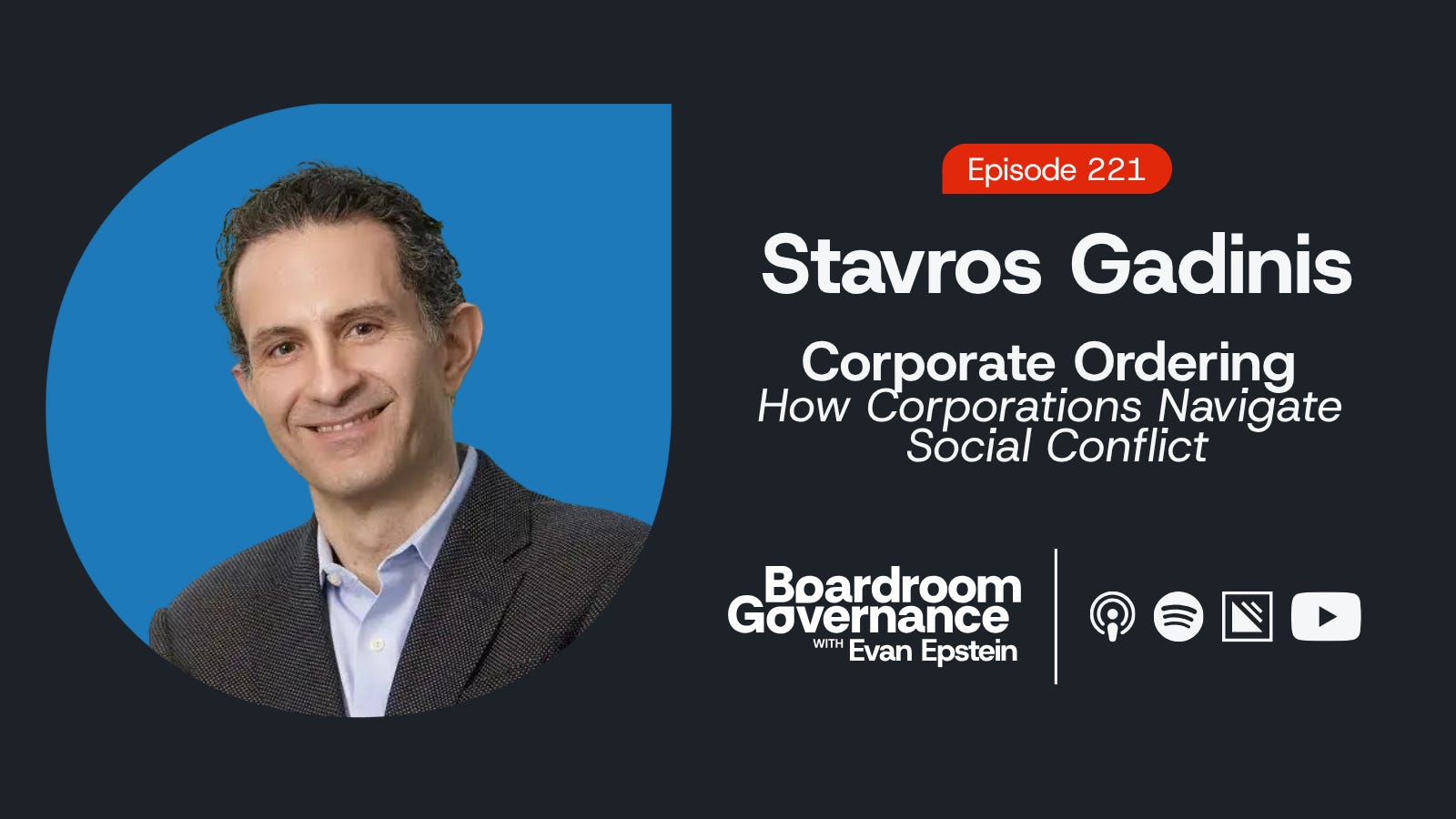
E221 Stavros Gadinis: Corporate Ordering. Stavros Gadinis, Professor of Law at UC Berkeley and author of Corporate Ordering, joined the Boardroom Governance Podcast to explore how companies create rules, make decisions, and hold leaders accountable. We discussed AI governance at Microsoft, OpenAI, and Anthropic, the role of the general counsel, and how boards can navigate social conflict and technological change.
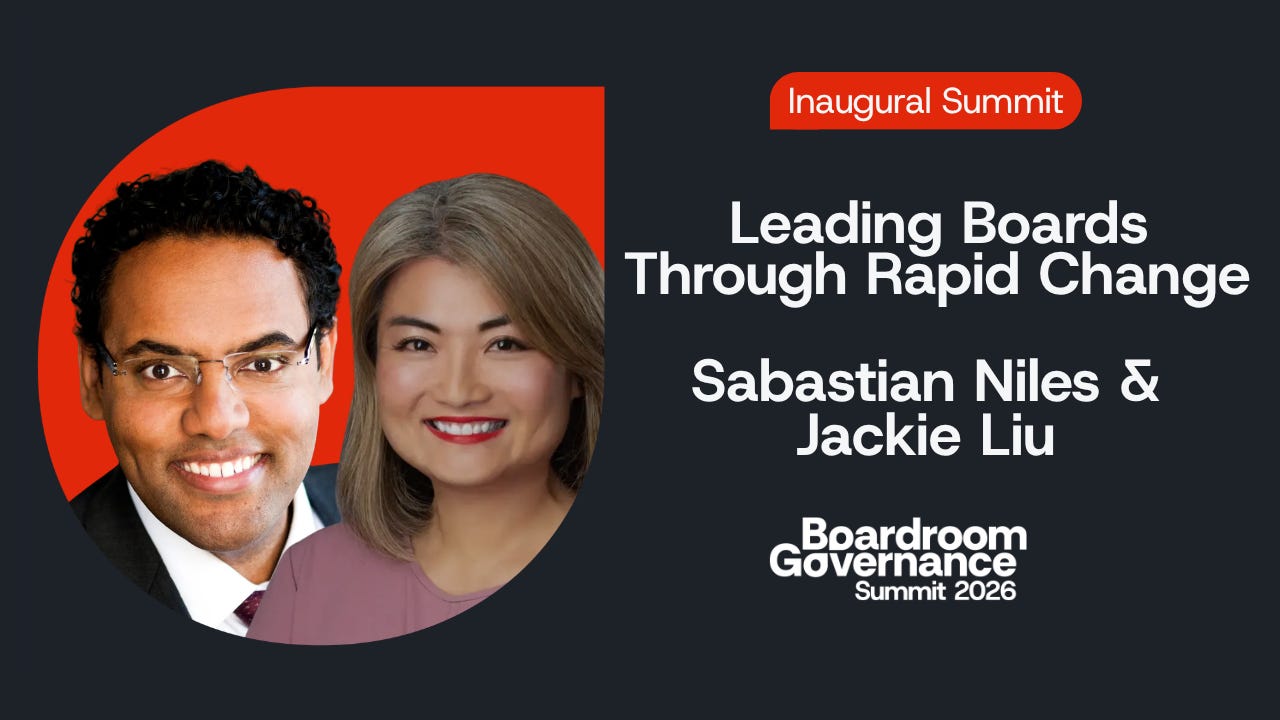
Leading Boards Through Rapid Change with Sabastian Niles and Jackie Liu. In the third episode of our Boardroom Governance Summit series, Sabastian Niles, President and Chief Legal Officer at Salesforce, and Jackie Liu, Partner at Morrison & Foerster and a board member at CEVA, discuss board leadership at the pace of change. Recorded at the Boardroom Governance Summit in Healdsburg, California, on August 27, 2026.
You can watch or listen to all the Boardroom Governance Podcast episodes in your favorite apps including YouTube, Apple, Spotify and Simplecast.
If you like this show, please add your rating and review on Apple Podcast or subscribe to the YouTube Channel. It will help others find the podcast 🙏
The podcast is sponsored by The American College of Governance Counsel.
Other Relevant Corporate Governance News and Content
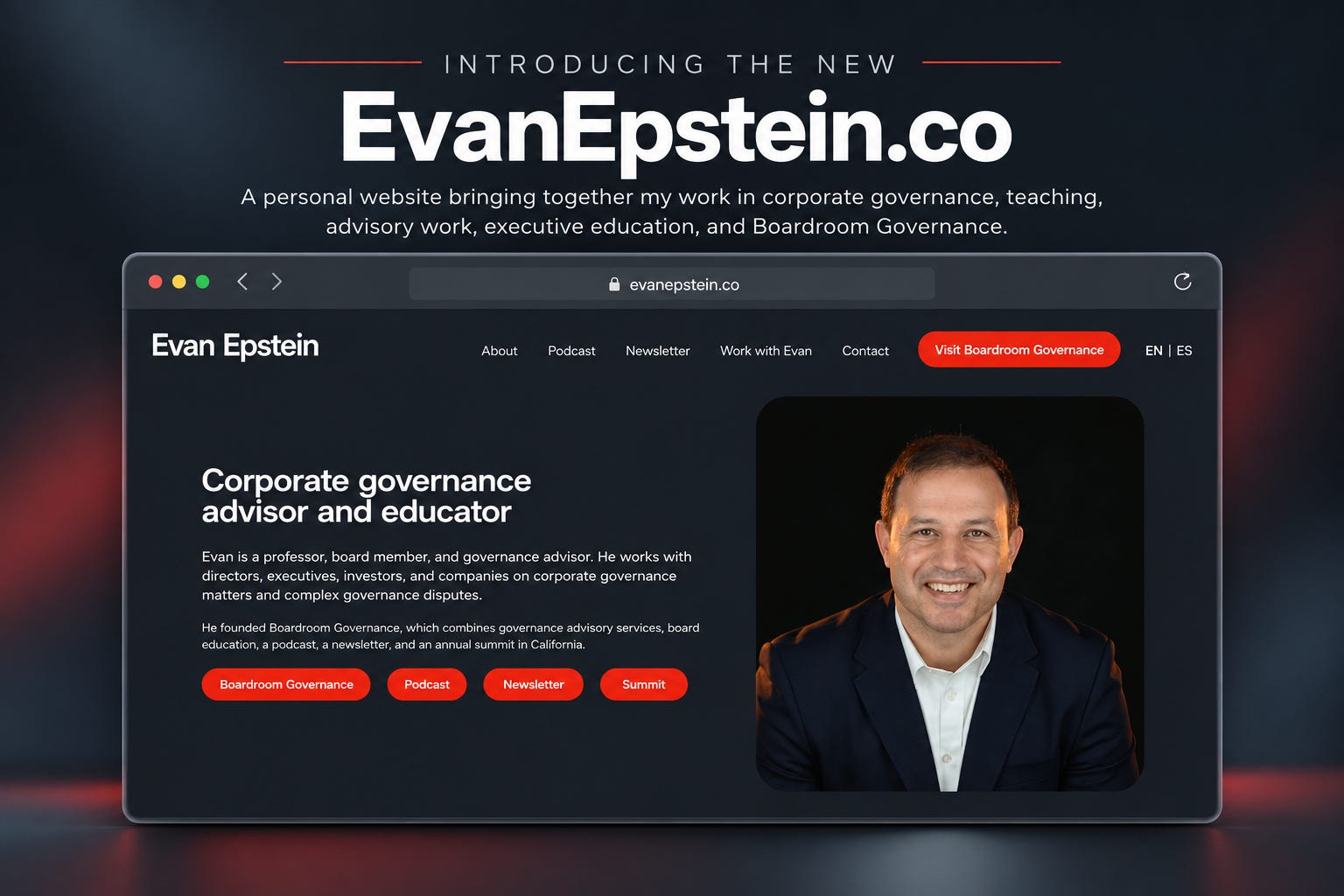
New: EvanEpstein.co: I recently launched a personal website bringing together the different parts of my work, including Boardroom Governance, teaching, governance advisory, expert engagements, executive education, and board service. The site complements Boardroom-Governance.com, the corporate platform that hosts many of these activities.
The SEC proposes eliminating the federal shareholder-proposal rule
The SEC has proposed rescinding Rule 14a-8, leaving shareholder proposals to state law and company governing documents. If adopted, the change would significantly reshape shareholder engagement and the proxy process.Delaware Chancery Decision Highlights Risks of AI-Generated Transcripts of Board Meetings. In its August 28 decision in ATG Capital Opportunities Fund LP v. Lane, the Delaware Court of Chancery considered AI-generated transcripts that revealed context about the board’s objectives and deliberations absent from its official minutes. The case underscores the importance of clear policies governing AI tools, confidentiality, and board records.
PwC 2026 Annual Corporate Directors Survey. This survey finds that 71% of directors identify AI as their board’s leading skills gap. Yet 81% prioritize cultural alignment in director recruitment, compared with 27% for specialized expertise.
AI startups clash over a board observer’s move to a rival. Factory AI and Cognition, two high-profile San Francisco-based AI startups building coding agents, are publicly feuding over the departure of a former Factory board observer and advisor who is joining Cognition as chief revenue officer.
“It feels as though ethics is being thrown out of the window in the AI era,” Grinberg, the CEO of Factory AI, wrote on X. “For weeks, while he sat in our board meetings and advised our leadership team, he was also confiding with executives of our largest competitor.”
Following Factory’s public spat with Vinod Khosla, an investor in both companies who sided with Cognition, Menlo Ventures announced its investment in Factory.
Joe Gebbia leads the launch of America.gov. Airbnb cofounder Joe Gebbia is leading an AI-powered portal designed to simplify access to federal services. The initiative offers a prominent test of AI deployment in government, with implications for accountability, privacy, and public trust.
AMD moves to acquire Fei-Fei Li’s World Labs. AMD announced an $8.2 billion agreement to acquire World Labs, just 2.5 years after its founding. Upon closing, Stanford computer science professor Fei-Fei Li, often called the “godmother of AI,” would become AMD’s executive vice president and chief scientist, reporting to Lisa Su.
Peter Thiel: The AI Crisis, Europe’s Decline & the Battle for America. In conversation with Germany’s Mathias Döpfner, Peter Thiel discusses AI, Europe’s technological competitiveness, and his views on democracy. A provocative discussion of the relationship between technological progress, political power, and the future of the West.
You Can See Everything. A24’s documentary from Nathan Fielder and Lance Oppenheim follows Elizabeth Holmes in the weeks before her imprisonment. Opening October 16, the film revisits one of Silicon Valley’s most notorious founders.
The Horowitz Andreessen Academy. Venture capital firm a16z is investing $35 million in a two-year alternative to college, supported by major tech companies. The San Francisco academy will emphasize AI, hands-on projects, and entrepreneurship, welcoming its first students in 2027.
In this Spanish-language column, my fellow Co-Chair of the Chile California Council and I reflect on the Council’s AI mission to Silicon Valley. We call for a more urgent, coordinated national conversation in Chile about AI, productivity, talent, and technological sovereignty.
Boardroom Governance Summit 2027: Registration Is Open. Join us August 25–27, 2027, at Limerick Lane Cellars in Healdsburg, California. Registration is now open. For a look at the conversations and community behind the Summit, read my recap of our inaugural gathering.
Onward and upward.
Sincerely,
Evan Epstein
Boardroom Governance | Personal Website | YouTube | LinkedIn | Podcast | Twitter
Current members of Anthropic’s board of directors include Dario Amodei, Daniela Amodei, Yasmin Razavi, Reed Hastings, Chris Liddell, and Vas Narasimhan.
The current trustees are Neil Buddy Shah, Richard Fontaine, and former Federal Reserve Chair Ben Bernanke. The trust has three members rather than its usual five, following last month’s departure of Mariano-Florentino Cuéllar, a former California Supreme Court justice and Stanford Law professor, to become Anthropic’s chief global affairs officer. According to The Information, citing a person familiar with the matter, trustees receive hundreds of thousands of dollars annually but no equity. They frequently attend board meetings and advise on policy and safety.
The release-dispute example also has a timing problem. A trust could hold substantial board rights yet be unable to intervene before a model ships. I’d look for who can pause a release while a disagreement is resolved, what evidence they receive, and whether management can resume deployment without a fresh decision.