
Public Company, Private Control
Boardroom Governance Newsletter #78 | July 7, 2026


The biggest Silicon Valley governance story this month is SpaceX. On June 12, 2026, the company began trading on the Nasdaq Global Select Market and Nasdaq Texas under the ticker SPCX 0.00%↑ after pricing its IPO at $135 per share. The offering raised approximately $75 billion before the underwriters’ option, making it one of the largest and most closely watched IPOs in history. SpaceX later announced that the full underwriters’ option had been exercised, bringing gross proceeds to approximately $85.7 billion.
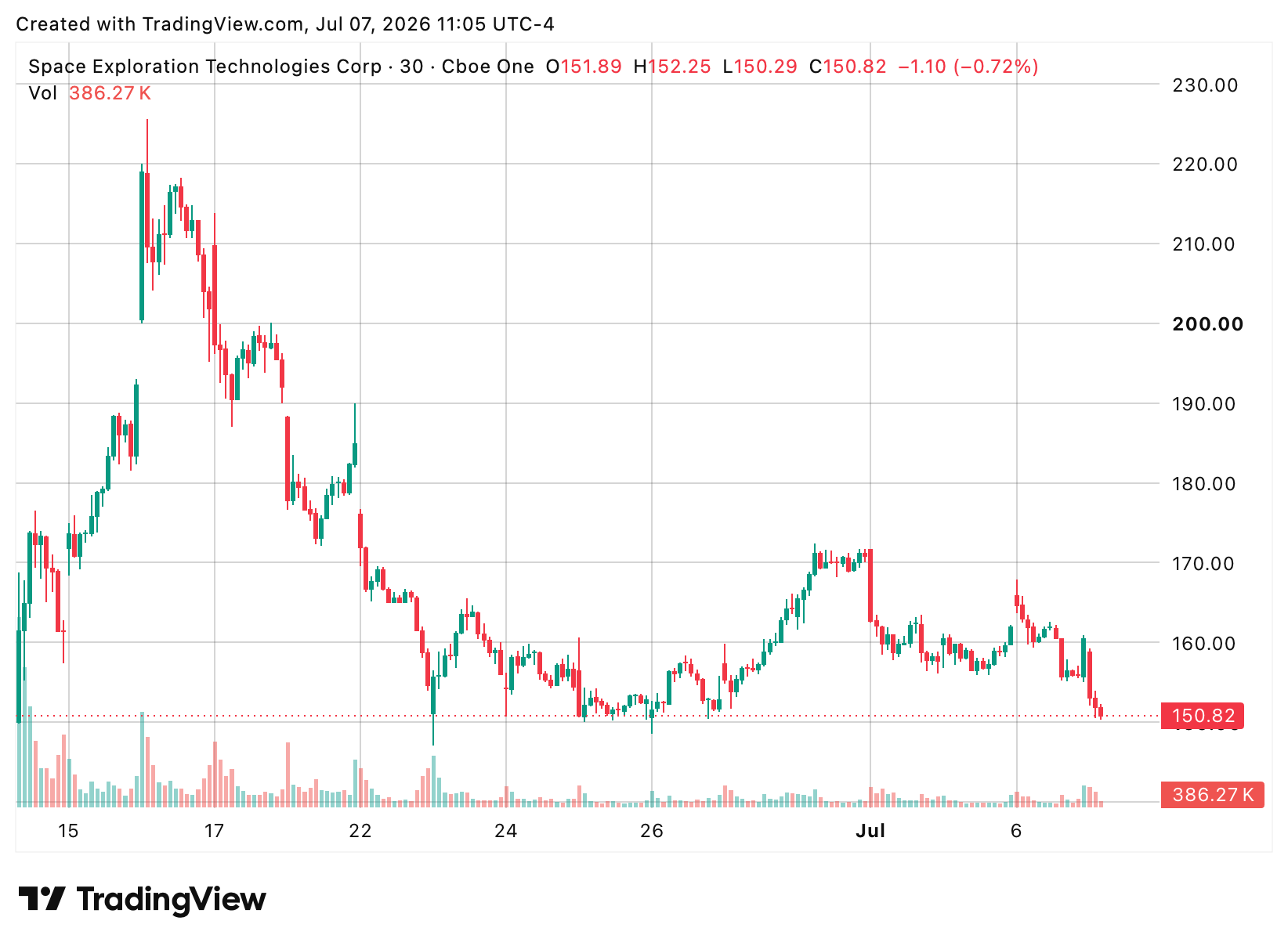
That is the capital markets story. The governance story is more interesting because SpaceX is now a public company, but not in a way that gives public shareholders much practical influence. SpaceX combines supervoting shares, mandatory arbitration, shareholder proposal restrictions, Texas corporate law, and controlled-company status to preserve Musk’s authority and limit shareholder influence. Elon Musk holds 42.5% of the company’s equity and close to 85% of the voting control. In other words, public investors can now buy SpaceX, but they are not being invited to govern SpaceX in any conventional sense.
SpaceX Governance Reading List
SpaceX IPO Gives Musk Sweeping Power and Curbs Shareholder Rights.
A Message From the SEC’s Uyeda: If You Don’t Like SpaceX’s Governance, Don’t Buy the Shares. SEC Commissioner Mark Uyeda discusses the limits of the SEC’s disclosure-based review, dual-class shares, related-party transactions, index ownership, and whether investors can realistically avoid SpaceX stock.
How Supervoting Shares Tighten Musk’s Iron Grip on SpaceX. The Wall Street Journal analyzes Musk’s voting power, his combined chair, CEO, and CTO roles, shareholder litigation limits, and the possibility that control could continue through permitted transfers.
SpaceX to Drive a Cybertruck Through Corporate Governance Norms. The Financial Times argues that SpaceX’s IPO structure gives Musk extraordinary freedom while offering public shareholders unusually limited accountability protections.
Top IPO, Weak Governance. Lucian Bebchuk and Kobi Kastiel argue that Musk could substantially reduce his economic ownership while retaining control, creating a potential small-minority-controller problem.
No Votes, No Sales, No Suits. Ann Lipton explains how SpaceX weakens the three traditional protections available to shareholders: the ability to vote, sell, and sue.
SpaceX’s IPO Filing and the Expanding Use of Litigation Deterrence Provisions. The D&O Diary examines SpaceX’s arbitration, class-action waiver, ownership threshold, and forum-selection provisions, and whether they could become a model for future IPOs.
SpaceX Becomes the First Major IPO Issuer to Implement the SEC’s New Shareholder Arbitration Policy. This piece explains why SpaceX could become an important test of whether federal securities claims can be moved from class-action litigation into private arbitration.
CII Letter to SpaceX. The Council of Institutional Investors objects to SpaceX’s dual-class structure, lack of a meaningful sunset, combined leadership roles, controlled-company exemptions, and shareholder litigation restrictions.
Letter to SpaceX Regarding Its IPO Governance. The New York City Comptroller, New York State Comptroller, and CalPERS call for one-share, one-vote, a majority-independent board, the elimination of Musk’s removal protections, and the removal of mandatory arbitration.
States Challenge Nasdaq, FTSE Russell for Fast-Tracking SpaceX. Reuters examines concerns that accelerated index inclusion could force passive funds to buy SpaceX shares despite the company’s unusually restrictive governance structure.
However, as with many founder-led companies, the investment thesis ultimately rests on Elon Musk himself. At this stage, it is difficult to bet against him. Whatever one thinks of his politics, management style, or the governance protections available to public shareholders, SpaceX is an extraordinary success story and perhaps the clearest example of the builder ethos. Founded in 2002 around an ambition that many considered unrealistic, the company went on to create the world’s only fleet of reusable orbital rockets, turn reusability into the foundation of a high-cadence launch business, build Starlink into a global connectivity platform, and become the world’s leading launch provider. SpaceX’s IPO roadshow presentation describes the company simply: “At our core, we are builders.” In this case, the description is hard to dispute.
The bullish case, therefore, is not simply that Musk is a charismatic founder or that investors are prepared to overlook weak governance. It is that his concentrated authority helped SpaceX make long-term technical and capital commitments that a more conventional company might have resisted. SpaceX repeatedly attempted things that looked improbable, absorbed years of failures and enormous capital requirements, and converted those bets into reusable rockets, launch infrastructure, satellite connectivity, human spaceflight, and now a broader platform spanning space, communications, and AI. Its roadshow makes clear that the company still sees itself as a builder of infrastructure rather than merely a provider of products or services.
For all the legitimate questions about accountability, succession, conflicts across the Musk ecosystem, and limited shareholder rights, SpaceX is also a reminder of why Silicon Valley has often tolerated founder control. Sometimes the founder actually builds the future that investors were promised. That does not make the governance concerns disappear. In fact, SpaceX may test the outer limits of what public investors are willing to tolerate in exchange for access to an exceptional founder and company. At what point does confidence in the builder become a willingness to hand over the keys, abandon meaningful shareholder rights, and accept governance in name only? There should be a tolerable limit, even for Elon Musk.
That makes the role of the board especially important. One would hope that SpaceX’s directors can provide genuine oversight, challenge management when necessary, manage conflicts across the broader Musk ecosystem, and serve as a credible source of accountability. A board should not merely be a cheering and applauding crowd. The stronger the founder’s control and the weaker the rights of public shareholders, the more important it becomes for the board to demonstrate independence in practice.
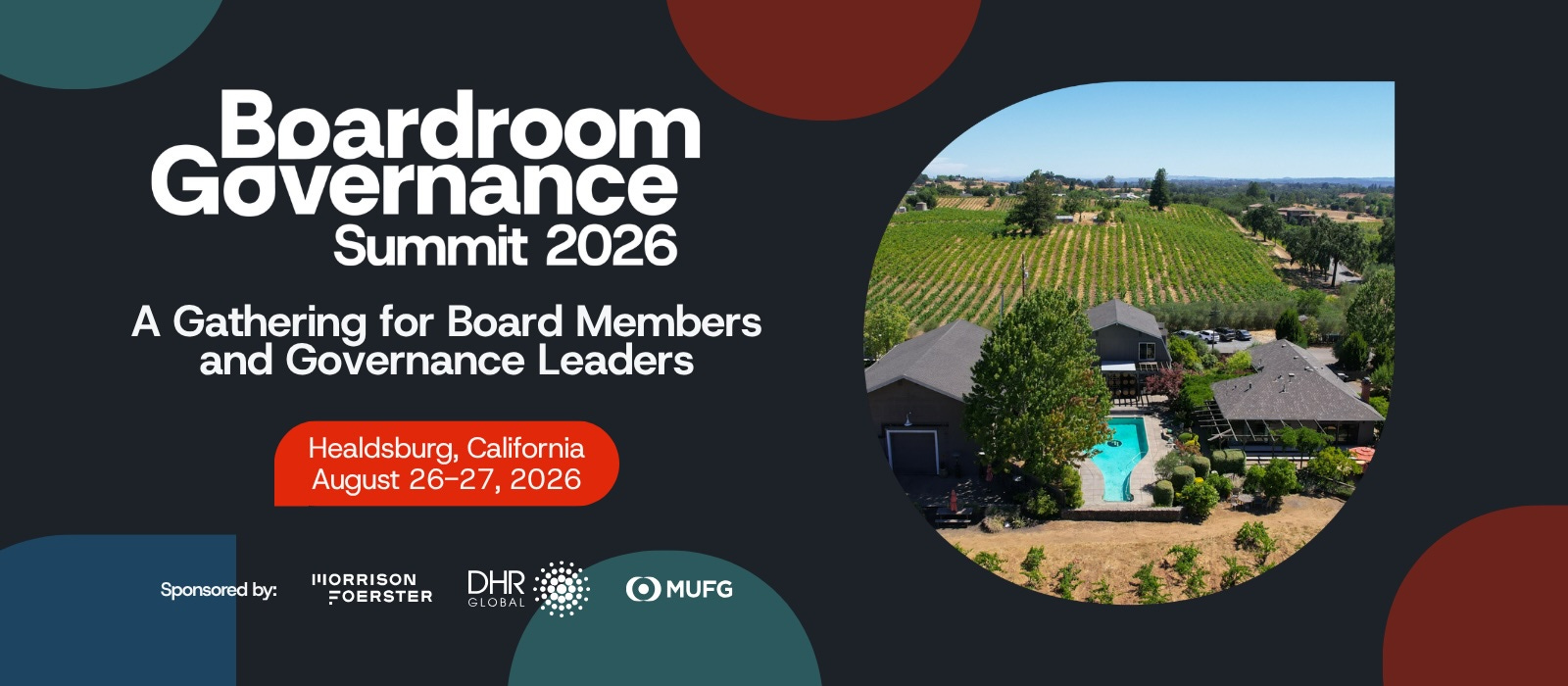
Directors: we are now ~7 weeks out from the inaugural Boardroom Governance Summit 2026, and we have a few spots left for directors who want to attend and take part in the conversation. Join us August 26 to 27 in Healdsburg. We’ll open with Leo E. Strine, Jr., former Chief Justice of the Delaware Supreme Court, and continue with candid boardroom conversations featuring directors and executives from companies including Arista Networks, Astera Labs, Box, Carlyle, DocuSign, GlobalFoundries, Illumina, Lumentum, Okta, Polestar, Salesforce, ServiceNow, Snowflake, Twilio, and United Airlines.
Space is limited. The Summit is sponsored by Morrison & Foerster, DHR Global, and MUFG. Register here: https://luma.com/BGPsummit
Boardroom Governance Podcast 🎙️
My latest episodes are listed below.
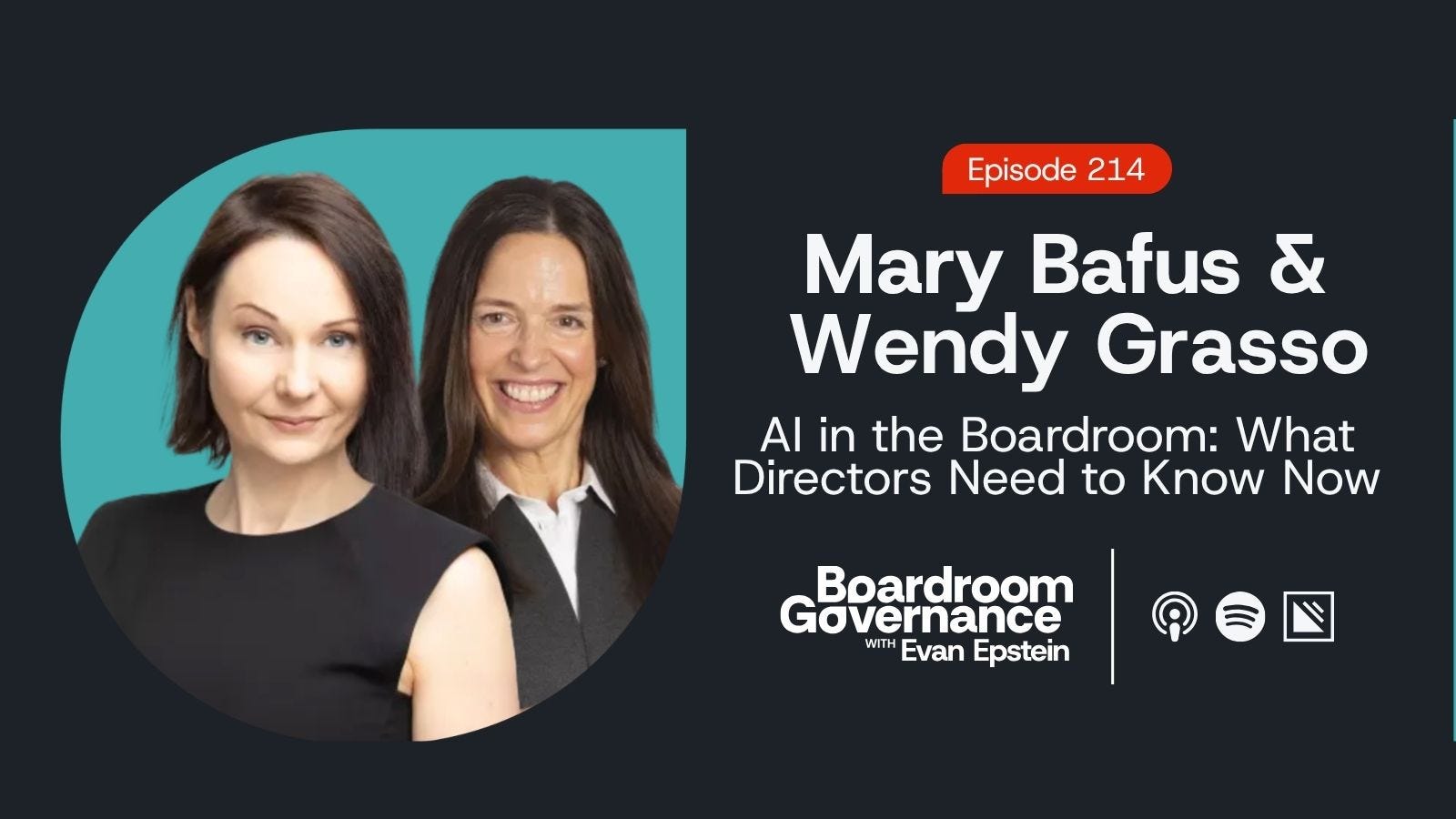
E214 AI in the Boardroom: What Directors Need to Know Now. Marie Bafus and Wendy Grasso of Fenwick joined me to discuss what directors need to know about AI now. We covered board oversight, Caremark duties, mission-critical risk, board minutes as litigation evidence, AI washing, disclosure, confidentiality, privilege, AI usage policies, and how boards can use AI responsibly without crossing into management.
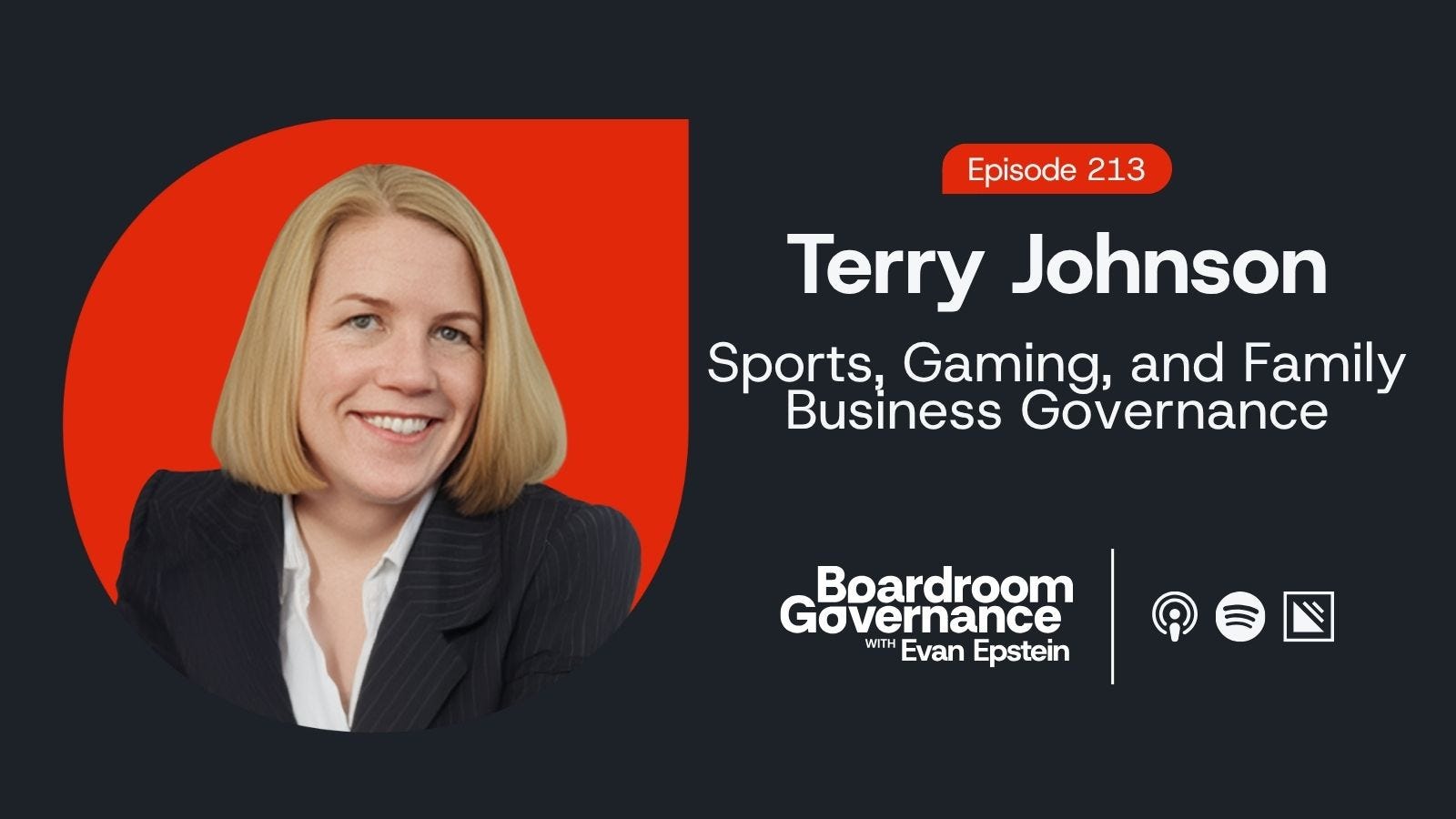
E213 Sports, Gaming, and Family Business Governance. Terry Johnson, partner at WilmerHale and Co-Chair of the firm’s Sports & Gaming Practice, returned to discuss sports governance, gaming, family businesses, and family offices, including the sports investment boom, league ownership models, betting and integrity, women’s sports, and college sports revenue sharing.
E212 Private Equity Boards and the Turnaround Playbook. Keith Giarman, Managing Partner of the Private Equity Practice at DHR Global, and Tony Abate, experienced board chair, director, investor, and operating executive, joined me to discuss private equity boards, turnaround governance, board effectiveness, board agendas, AI and board talent, underestimated governance risks, and the difference between founder-led and board-led companies.
E211 Informed Oversight Without Operational Interference. Throughout her twenty years as a corporate director, Emily Liggett has served on 18 public, private and non-profit boards. She currently serves on the boards of Ultra Clean Technology and Materion Corporation. She also serves as Lecturer at Stanford GSB, where she teaches board leadership. We discussed board matters, CEO mistakes, AI governance, innovation, oversight, and teaching the next generation of governance leaders.
E210 Venture Capital in the AI Supercycle. Greg Gretsch, Founding Partner and Managing Director of Jackson Square Ventures, returned to the Boardroom Governance Podcast to discuss the AI supercycle, venture capital, SaaS disruption, startup costs, private markets, IPOs, data centers, regulation, and how boards should think about AI strategy.
You can listen to all the Boardroom Governance Podcast episodes in your favorite apps including Apple and Spotify.
If you like this show, please add your rating and review on Apple Podcast. It will help others find the podcast 🙏
If you or your organization is interested in sponsoring the podcast, I would love to hear from you.
The podcast is sponsored by The American College of Governance Counsel.
Other Relevant Corporate Governance News and Content
OpenAI proposes handing Trump administration 5% stake. OpenAI has floated giving the US government a roughly 5% equity stake, framing it as a way to give the public a financial stake in AI’s upside and to smooth relations with the Trump administration amid growing political and regulatory scrutiny. Sam Altman has raised the idea in early talks with Trump, Lutnick, and Bessent, and has suggested other major labs like Anthropic, Google, and Meta do the same by allotting equity to a sovereign wealth vehicle, though the discussions are conceptual, may require an act of Congress, and it is unclear whether rival companies would agree.
In San Francisco, Even $180,000 Tech Salaries Are No Longer Enough. This is quite a read.
This is extraordinary, and it has received far too little attention.
 Charlie Bilello@charliebilelloTotal amount wagered on sports in the US... 2025: $165 billion 2024: $149 billion 2023: $121 billion 2022: $93.7 billion 2021: $57.5 billion 2020: $21.5 billion 2019: $13.1 billion 2018: $6.6 billion
 Charlie Bilello @charliebilelloAmericans bet over $165 billion on sports last year, which is more than they spent on movies, books, concerts and sports tickets - combined.9:55 PM · Jun 28, 2026 · 3.97M Views271 Replies · 658 Reposts · 6.42K Likes


It Failed in France. It Would Be a Disaster in California.
“When corporate founders leave, hiring decisions tend to follow. Silicon Valley and other drivers of the state’s prosperity are not guaranteed to remain the unique and vibrant economic powerhouses they have been. The share of Californians employed at the state’s anchor companies has fallen steadily since 2015. Across the sectors those companies dominate, such as the booming technology industry, as many as a quarter of a million jobs have gone to other states. Imposing a wealth tax would accelerate this trend.”
American A.I. Companies Say Chinese Copycats Are Quickly Catching Up. U.S. companies complain that competitors in China are unfairly copying their A.I. systems using a technique that has been around for years.
“These distillation attacks are carried out illicitly, systematically and at industrial scale to harvest U.S. A.I. capabilities across frontier labs and repackage them as their own.” Anthropic, in a letter to Senators Tim Scott and Elizabeth Warren
DeepSeek Closes Record $7 Billion-Plus Funding with Unusual Deal Structure.
“The funding round, which values DeepSeek at more than $50B, requires investors to put their capital into a limited partnership managed by DeepSeek CEO Liang Wenfeng, instead of DeepSeek itself, as a way for Liang to ensure he retains absolute control of the company, the people added. It also imposes a 5-year lockup on all investors’ shares, during which they can’t sell their stakes, the people said.”
“The only exception is China’s National Artificial Intelligence Industry Investment Fund, which invests directly into DeepSeek without being subject to the lock-up, and enjoys voting rights at the company, the people said. The national fund is investing 1B yuan in the round.”
“In another unusual nature of the deal, Liang and his team also asked to check the identities of all the LPs behind the funds investing in the round, to weed out the possibility of shares ending up in the hands of unknown investors, one of the people with direct knowledge said.”
“Liang personally is writing the biggest check in the round, 20B yuan, followed by Tencent’s 10B yuan. Chinese battery giant CATL is investing 5B yuan, with e-commerce company JD.com, videogame publisher NetEase and venture-capital firm IDG Capital each contributing 3B yuan.”
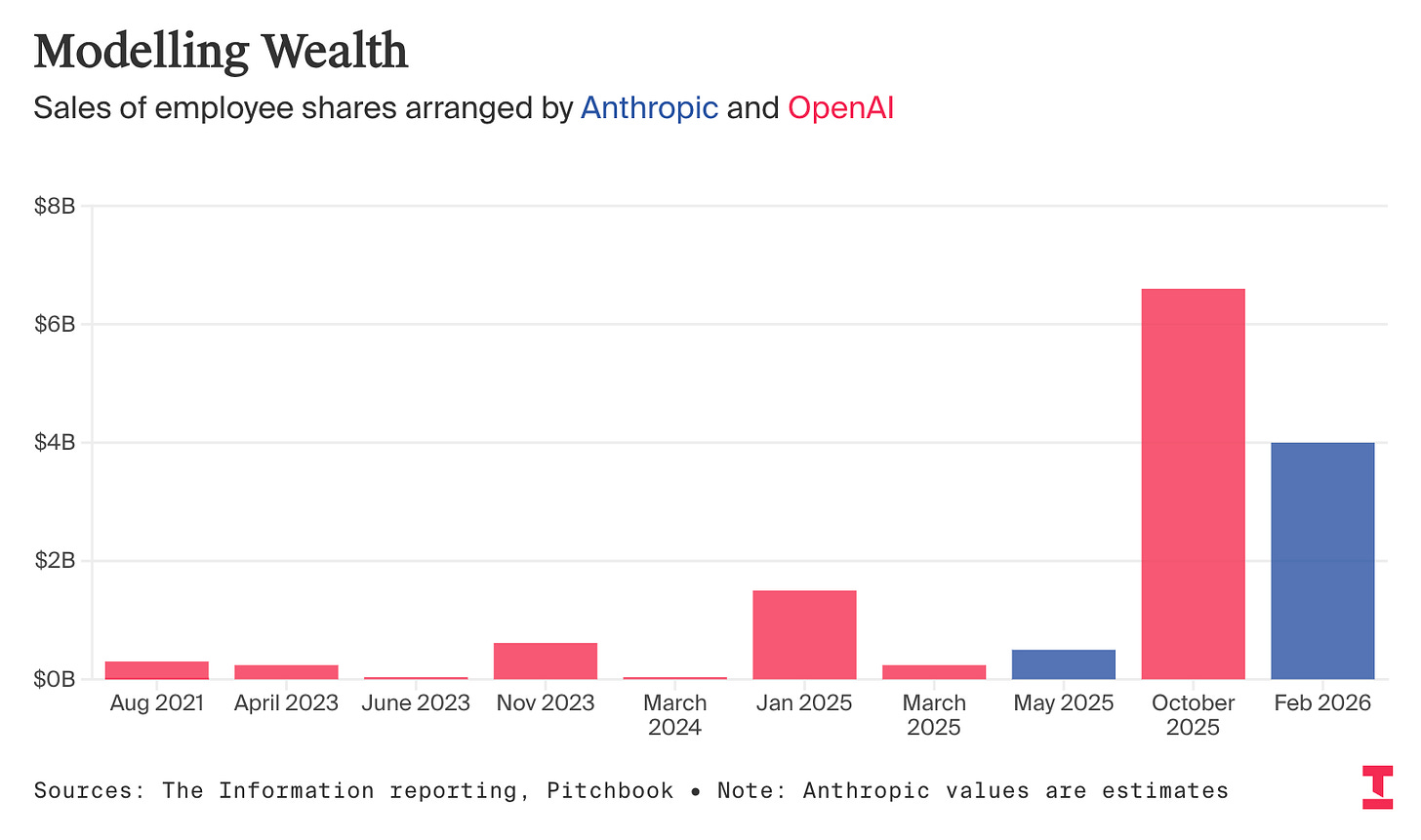
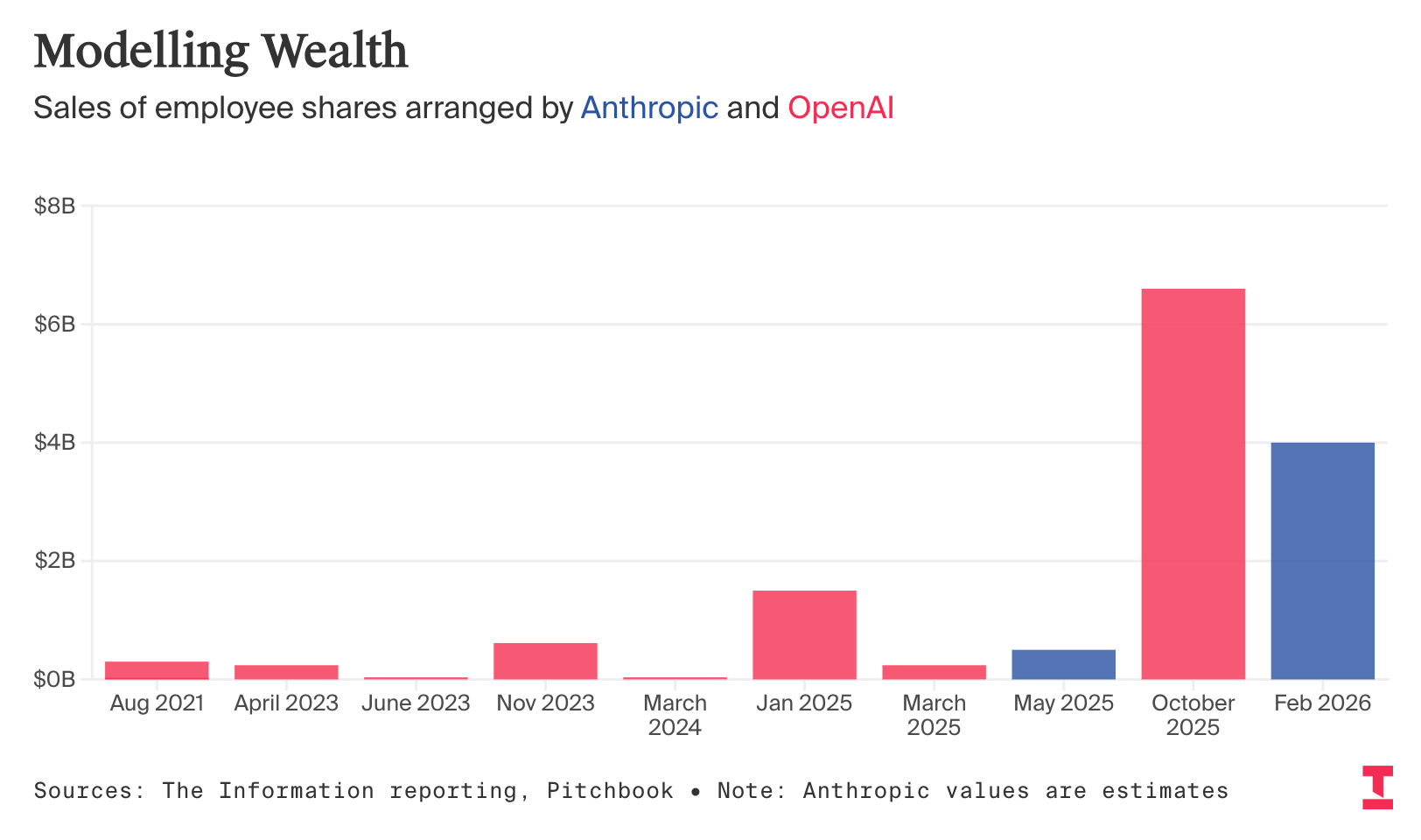
OpenAI, Anthropic Employees Have Already Cashed Out About $14 Billion. Neither company has gone public yet. Not long ago, the IPO was the liquidity moment. Private markets have changed dramatically.
Charlie Javice Has Been Seeking a Pardon From Trump After Defrauding JPMorgan. “White House officials are considering a plan for President Trump to issue 250 pardons as a way to mark the celebration of the nation’s 250th birthday this summer.”
She Confessed to Fraud. Her Board Let Her Stay in Charge. The final months of the fashion tech start-up CaaStle included fake audits, stock buybacks and a damage control strategy led by the chief executive who defrauded it.
‘Disrupted or dead’: AI is crushing a generation of startups built before ChatGPT
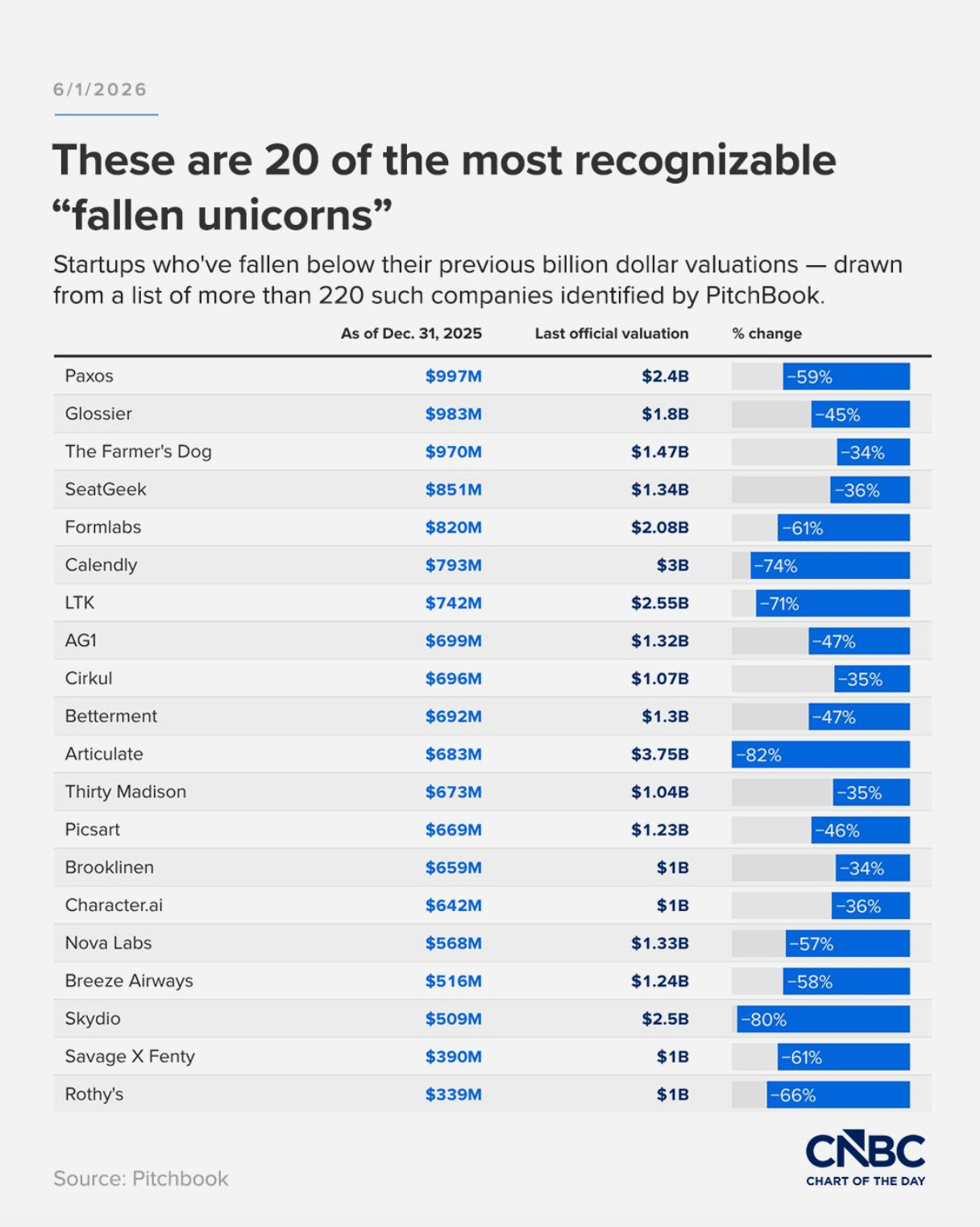
“Nearly half of America’s 857 unicorn startups haven’t raised fresh funding in three years, PitchBook data shows.”
“Startups that last raised in 2021 are worth 68% less on average, PitchBook found, while those that last raised in 2022 have seen their valuations decline 52%.”
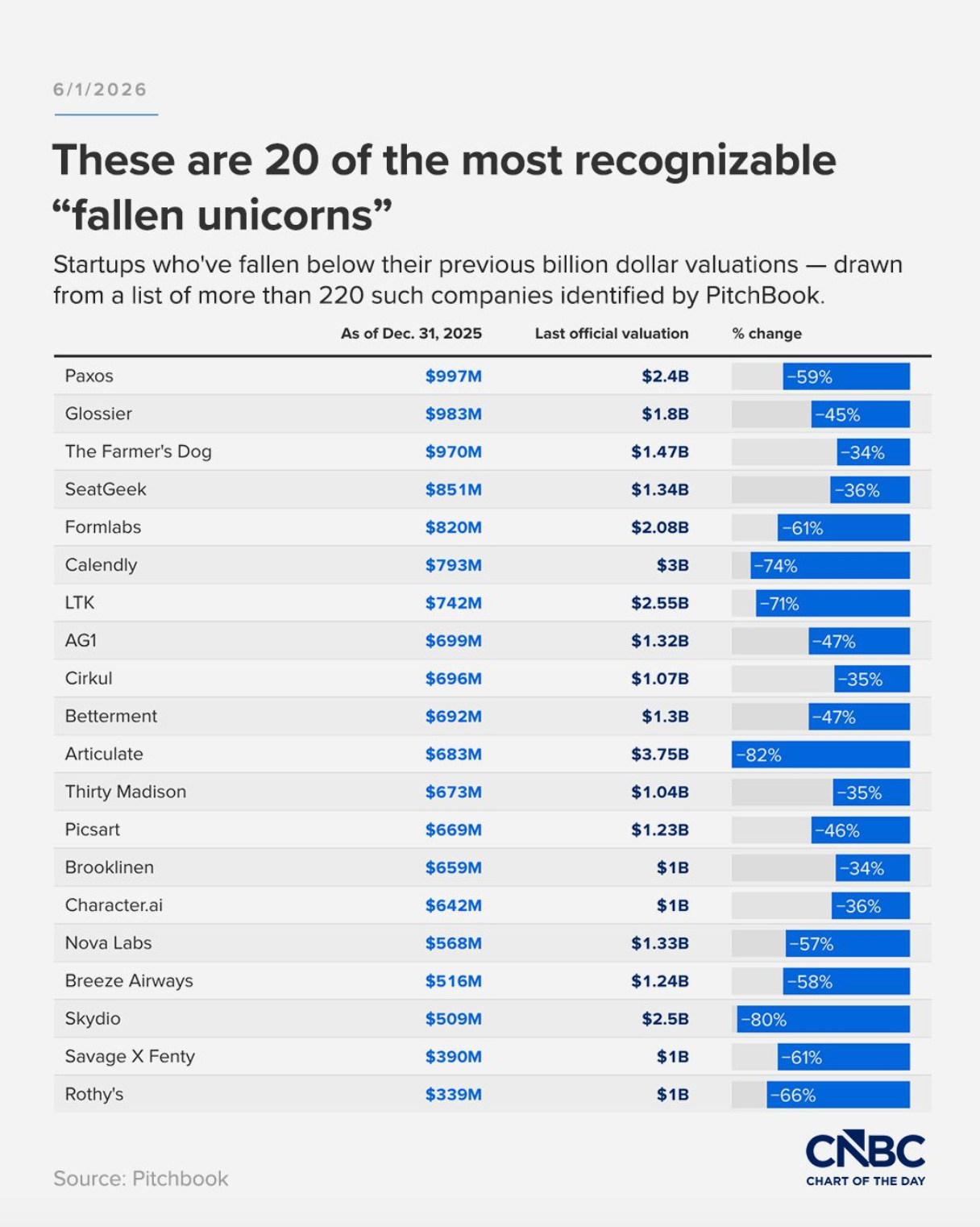
“More than 220 companies that once hit billion-dollar valuations are now considered “fallen unicorns” — including Glossier, Savage X Fenty, AG1 and The Farmer’s Dog, according to PitchBook, which provided a list of the companies exclusively to CNBC.”
“Largely to blame is the AI boom that has funneled more than $250 billion into OpenAI and Anthropic and reset valuations on entire classes of startups.”
You Have No Idea What a Trillion Dollars Is—and We Have Proof. I have written before about how a trillion has become the new billion. Not long ago, millions gave way to billions. Now company valuations, national debt, and even individual fortunes are measured in trillions. The problem is that most of us have no real sense of how large a trillion actually is.
Onward and upward.
Sincerely,
Evan Epstein