
Another Silicon Valley CEO Charged with Fraud
Boardroom Governance Newsletter #68 | Sept 3, 2025


In 2023, I wrote about the case of a unicorn company called IRL, a social media app for Generation Z, that shut down earlier that year.
The saga of IRL has now moved from the realm of civil litigation into the criminal courts. Last week, a federal grand jury in Oakland returned an eight-count indictment against the company’s founder and former CEO, Abraham Shafi, charging him with wire fraud, securities fraud, and obstruction of justice.
The indictment paints a picture of a startup built on smoke and mirrors. In the spring of 2021, IRL raised $170 million in its Series C round, led by SoftBank, at a $1 billion valuation. Shafi personally pocketed about $7.5 million by selling some of his own stock. At the time, he assured investors that IRL had reached 12 million monthly active users with “virtually zero” marketing spend, growing organically through viral SMS invites between friends. The story was compelling: authentic growth, meteoric adoption, and a product that had captured a quarter of U.S. teens.
But according to prosecutors, the reality was far less inspiring. Since at least 2019, IRL had been spending millions of dollars on so-called “incent ads”, paid schemes where users are rewarded in other apps for downloading IRL. These users, prosecutors allege, were less real community members than disposable clicks. To keep the illusion alive, Shafi is accused of funneling payments through a third-party shell, generating falsified invoices, and assuring investors that IRL’s marketing spend was only about $50,000 a month.
The money flowing in from SoftBank and others did not just prop up IRL’s inflated user metrics. Prosecutors say Shafi used more than a million dollars in company funds for himself: luxury hotels, designer clothes, a trip to Japan, and even his lavish 2022 wedding in Hawaii, where IRL allegedly paid for guests’ airfare and accommodations.
When the SEC began digging in 2022, Shafi allegedly turned to obstruction. The indictment claims he instructed an associate to delete or alter documents, pressured them to take the blame for falsified invoices, and then wiped his own iPhone by restoring it to an earlier backup just days before it was to be imaged in an internal probe. Under oath, he denied doing so.
For those who have followed IRL’s collapse, none of this comes entirely as a surprise. In 2024, the SEC charged Shafi with fraud, and that case was deemed related to the private action and assigned to the same district judge, Yvonne Gonzalez Rogers of the Northern District of California.
There is also counter litigation in Delaware, where the founders accuse the venture-backed directors of disloyalty and self-dealing in shutting down the company. Now the criminal case adds another layer of scrutiny, raising the stakes not just for Shafi but for the broader ecosystem of venture-backed governance.
The indictment is also a cautionary tale for investors and corporate directors. As Bloomberg’s Matt Levine noted in his characteristically dry way, sometimes “robust due diligence” can be as simple as spending a few days using the app. If your experience is endless groups called “Play Video Games” populated by bots, perhaps that tells you more than any glossy pitch deck.
IRL’s rise and collapse is emblematic of the post-unicorn reckoning. The funding boom of 2019 to 2021 rewarded hypergrowth at all costs, but as the tide has receded—except in AI, where investment continues to smash records—the aftermath has brought notable lawsuits, shutdowns, and even criminal charges.
We’re tracking some of these cases through our Startup Litigation Digest, which has covered 32 cases since 2023.
Boardroom Governance Podcast 🎙️
Check out my latest episodes:
E185 Teresa Briggs: Audit Committees, AI, and the Evolving Role of Corporate Directors. Teresa serves on the boards of ServiceNow, Warby Parker, Snowflake and DocuSign. She is a member of the audit committee for each company and is the audit committee chair of ServiceNow, DocuSign, and Warby Parker.
E184 Jonathan Foster: On Boards and the Playbook for Modern Governance. Jonathan Foster is an experienced corporate director, investment banker, and expert witness in corporate litigation. We talk about his new book “On Boards: The Modern Playbook for Corporate Governance,” and more.
E183 Larry Cunningham: From John Weinberg’s 1948 Thesis, Delaware’s Challenge, to the Modern Boardroom. Larry Cunningham is the Director of the John L. Weinberg Center for Corporate Governance at the University of Delaware. We discuss the 25th anniversary of the Weinberg Center, including Larry’s discovery of John Weinberg’s 1948 Princeton thesis, which has inspired a forthcoming book and an October 9 symposium hosted by the Center. We also talk about the current state of Delaware as a corporate home.
E182 Tina Rosenfeld: Independent Directors, Board Diversity, and Governance in Chile. Tina Rosenfeld is a corporate director, advisor, and educator with deep experience in international governance and strategy. Born in Germany and based in Chile, Tina has worked across Europe and Latin America, serving on boards of family businesses, startups, and publicly traded companies, while also mentoring the next generation of leaders.
You can listen to all the Boardroom Governance Podcast episodes in your favorite apps including Apple and Spotify.
If you like this show, please add your rating and review on Apple Podcast. It will help others find the podcast 🙏
If you and/or your organization is interested to sponsor the podcast, please do not hesitate to reach out to me!
The podcast is sponsored by The American College of Governance Counsel.
Other Relevant Corporate Governance News and Content
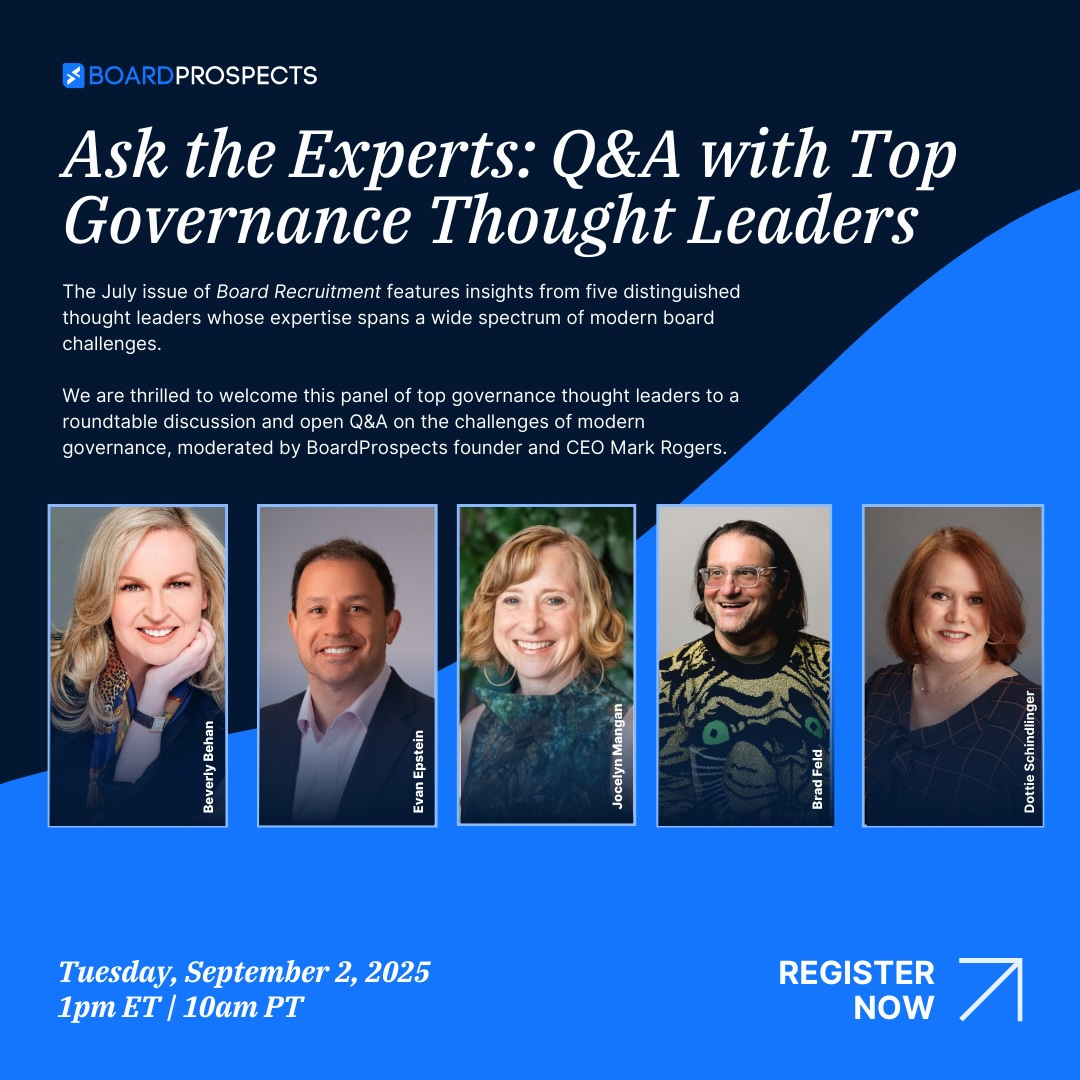
Yesterday I participated in a panel discussion with other governance thought leaders hosted by Board Prospects, for whom I wrote an article on startup litigation that appeared in the July issue of Board Recruitment magazine. It was an excellent discussion. I'll post the link once it becomes publicly available.
CII Fall Conference: San Francisco. I'll be moderating a panel on Leading on Governance in Silicon Valley at the Westin St. Francis on September 10, 2025 (9:30-10:15 AM). Please stop by and say hello if you’re at the CII conference.


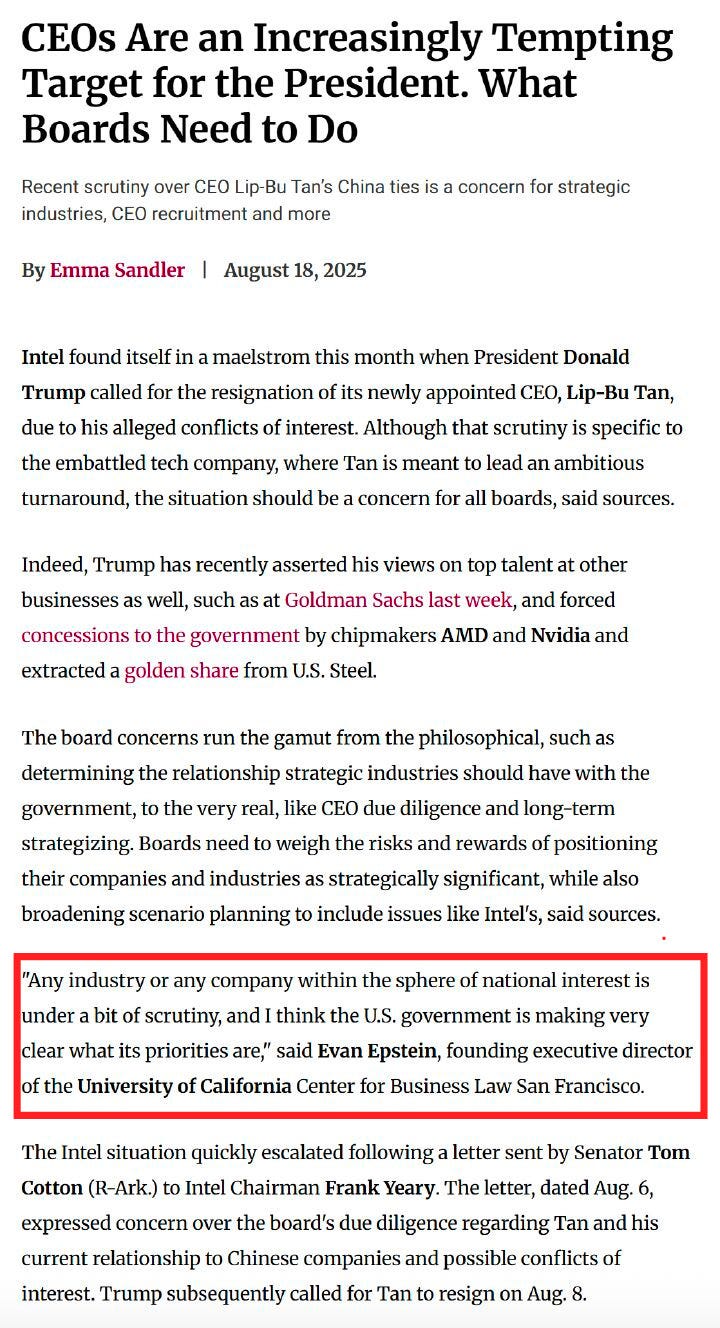
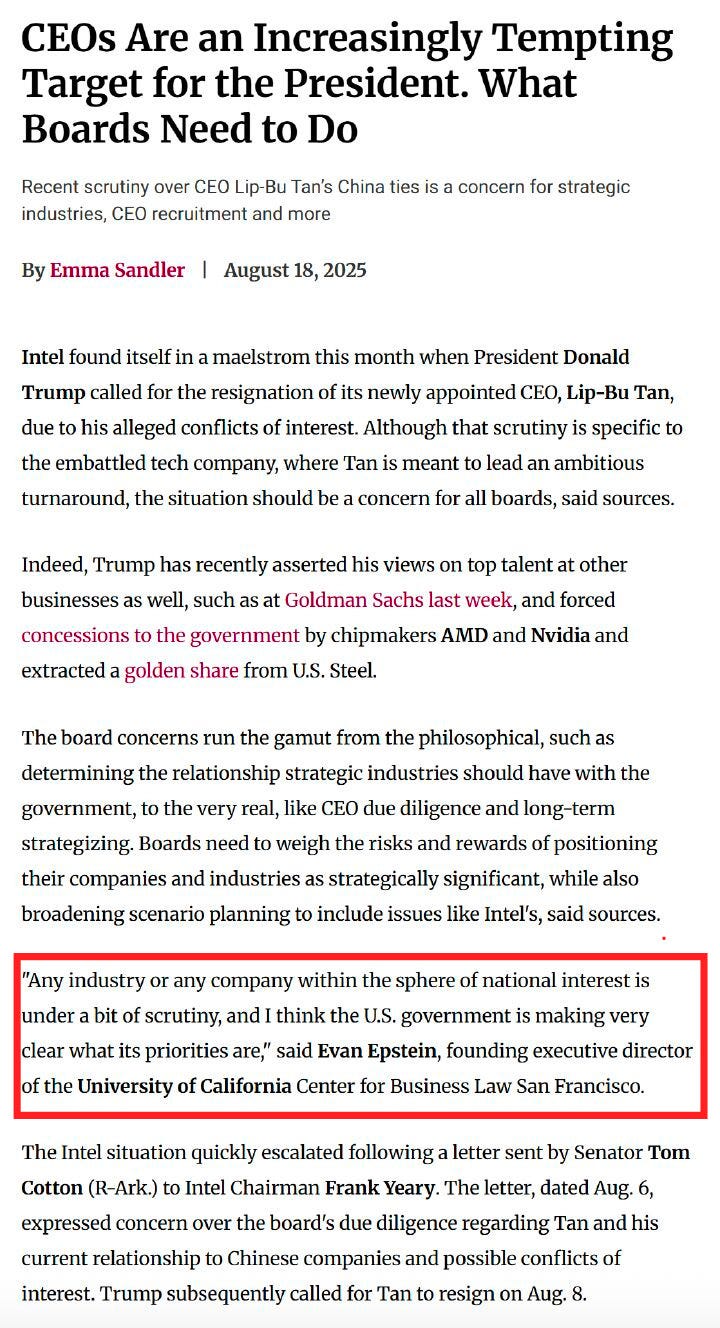
CEOs Are an Increasingly Tempting Target for the President. What Boards Need to Do. I was quoted on this Financial Times Agenda story on President Trump’s interaction with Intel’s CEO, and the role of the board in such situations.
Tesla approves share award worth $29 billion to CEO Elon Musk. Tesla’s board approved a 96M share grant (~$29B) for Elon, contingent on him remaining in a key executive role for two years, as the 2018 compensation package awaits Delaware Supreme Court review. Key concerns include board independence, succession planning, CEO time allocation, and ratification risks, plus the looming Texas vs. Delaware incorporation battle.
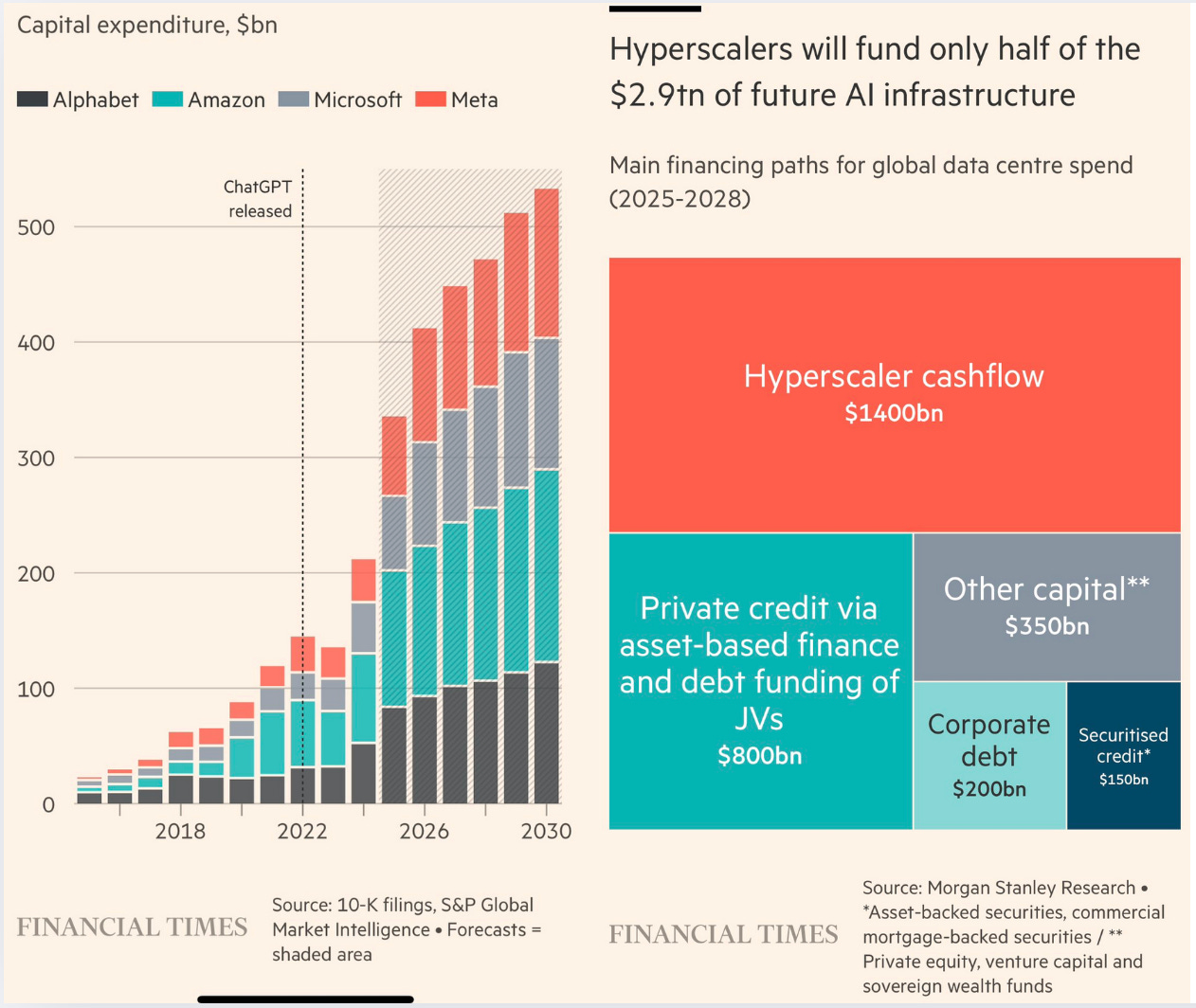
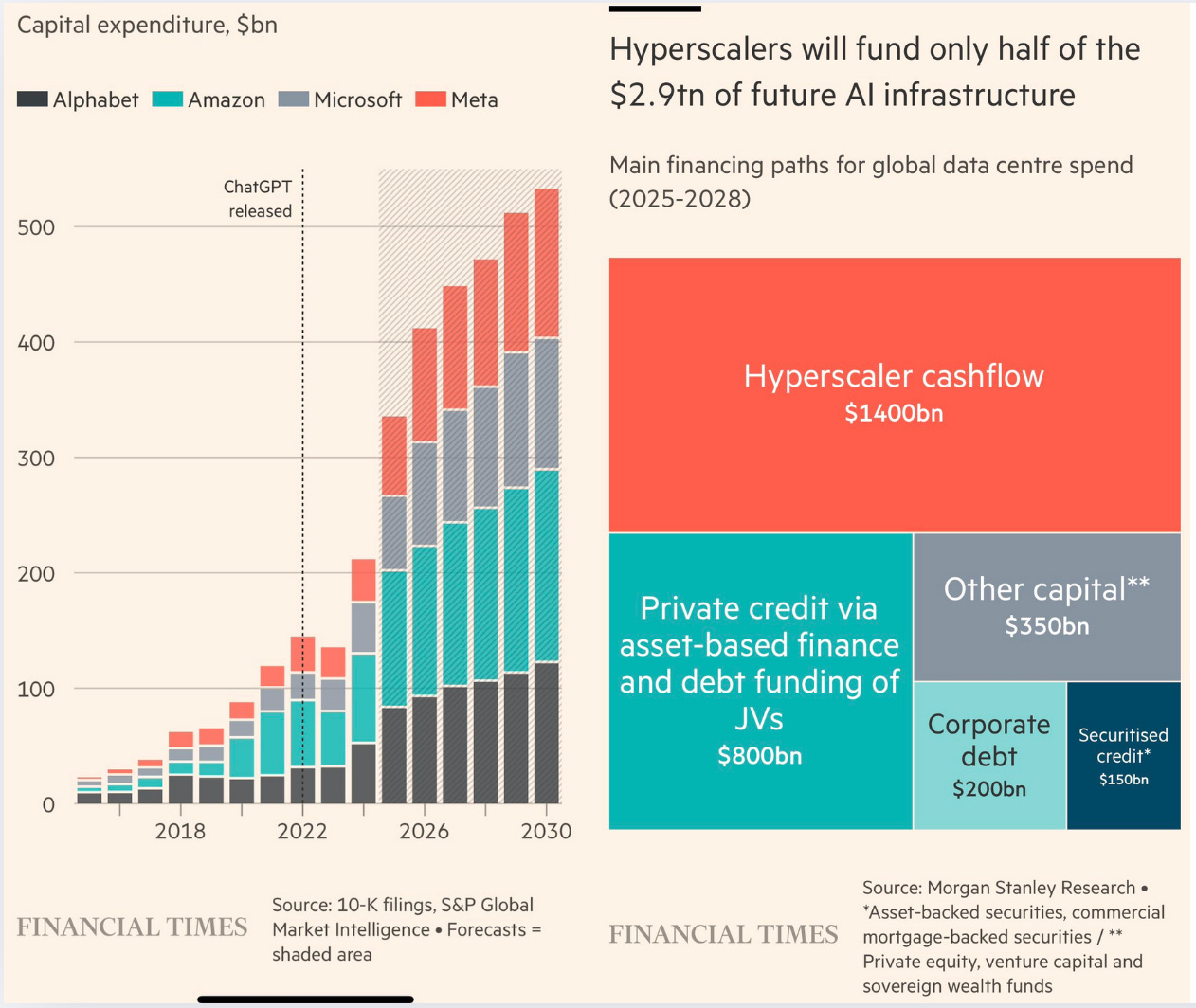
‘Absolutely immense’: the companies on the hook for the $3tn AI building boom. Data center spending will hit $3 trillion by 2029, according to Morgan Stanley. While Big Tech handles $1.4 trillion in capex, that leaves a massive $1.5 trillion opportunity for investors and developers.
Startup down rounds are at a 10 year high, according to PitchBook data. Not all sunshine in Silicon Valley: 15.9% of VC-backed deals in 2025 have been down rounds, a decade high, per Pitchbook.
Public equities have their Mag 7, and venture capital now seems to have its AI 10. With all the value concentration risk that entails. From NYT’s Dealbook (5/13/25): “There are now 498 A.I. unicorns, privately held start-ups valued at $1 billion or more, with a combined valuation of $2.7 trillion, according to CBinsights. About 100 of them were founded since 2023.” “35% of U.S. venture capital has beeen raised by just 10 companies so far this year.”
Nestlé Dismisses CEO Over Relationship With Subordinate. “Nestlé said that Mr. Freixe’s dismissal followed an investigation into a romantic relationship he had with a direct subordinate. The investigation was overseen by the company’s chairman, Paul Bulcke, and lead independent director, Pablo Isla, and included outside counsel.” Nestlé CEO’s Unraveling Started With a Tip to an Employee Hotline.
Why China Is Trying to Tame Its Electric Car Frenzy. “[F]ierce competition among automakers has gotten ruthless, with about 50 automakers fighting for customers by slashing prices again and again (…) The frenzy has captured the attention of the highest levels of China’s government. Officials have started a campaign against “involution,” which they define as excessive competition. “One force propelling China’s E.V. revolution that Beijing is unlikely to slow is the torrent of mechanical engineers graduating from universities — 10 times as many as in the United States. Two-thirds of Chinese youths now go to university, and while many struggle to find jobs, the auto industry is hiring engineers in large numbers. BYD alone employs 120,000 engineers, roughly the size of Tesla’s entire labor force.”
Anthropic raises $13B Series F at $183B post-money valuation. It was valued at $61.5 billion during a March funding led by Lightspeed. Iconiq led the Series F round, with Fidelity and Lightspeed listed as co-leads.
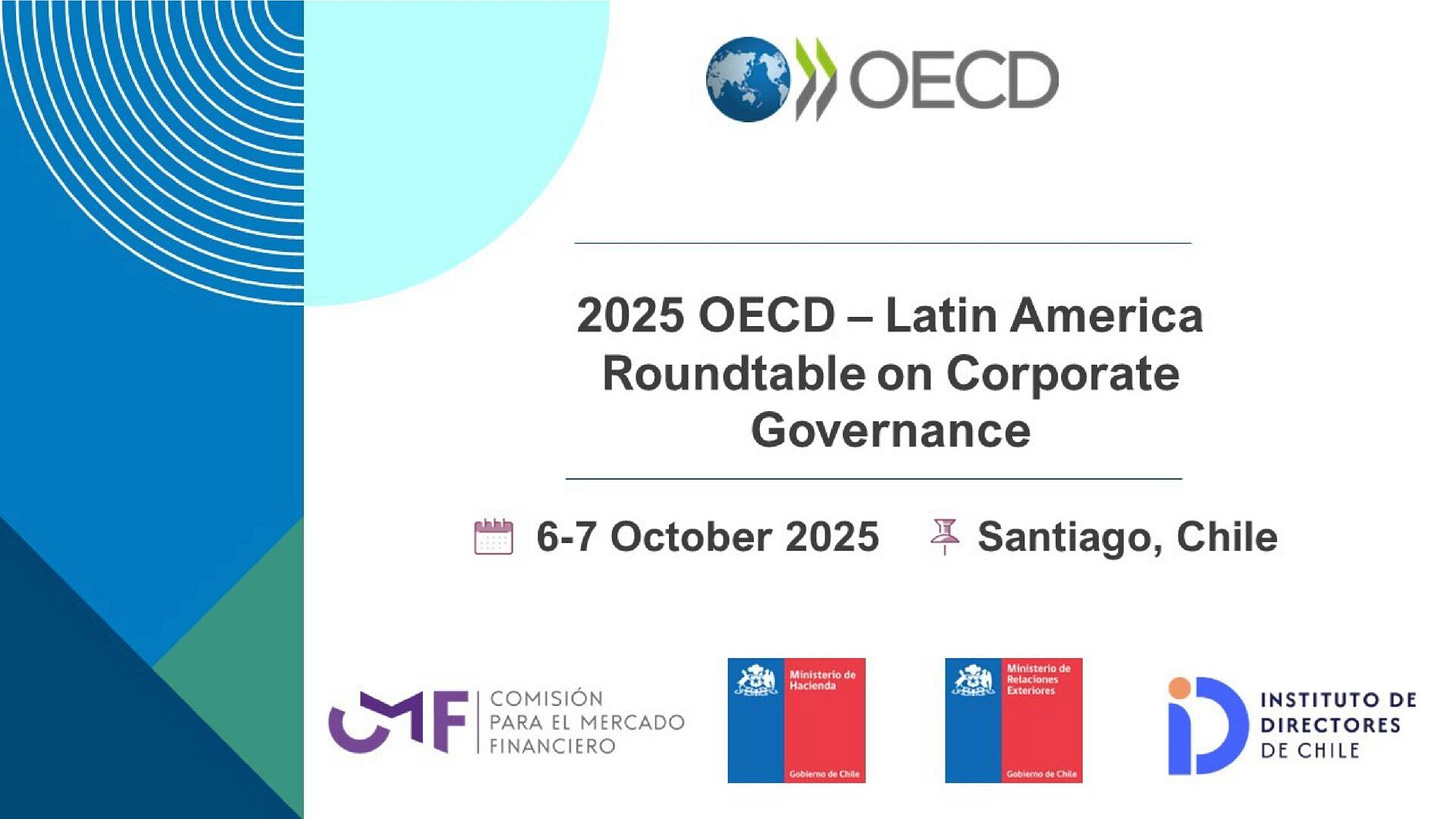
2025 OECD Latin America Roundtable on Corporate Governance. I look forward to reconnecting with many thought leaders from Latin America on October 6-7, 2025, in Santiago, Chile. I will be speaking on a panel on index and ESG rating and data providers in the broader corporate governance context.
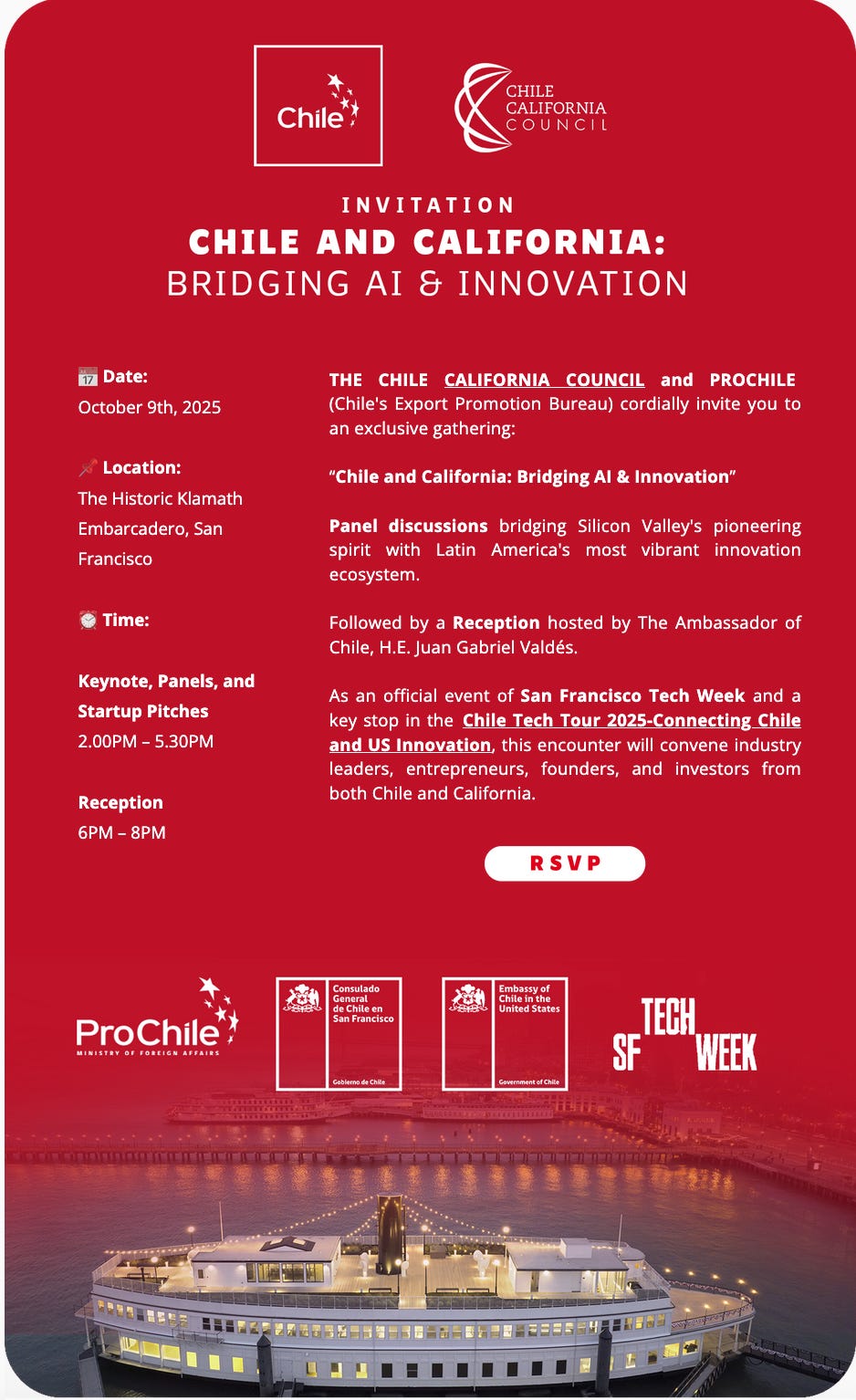
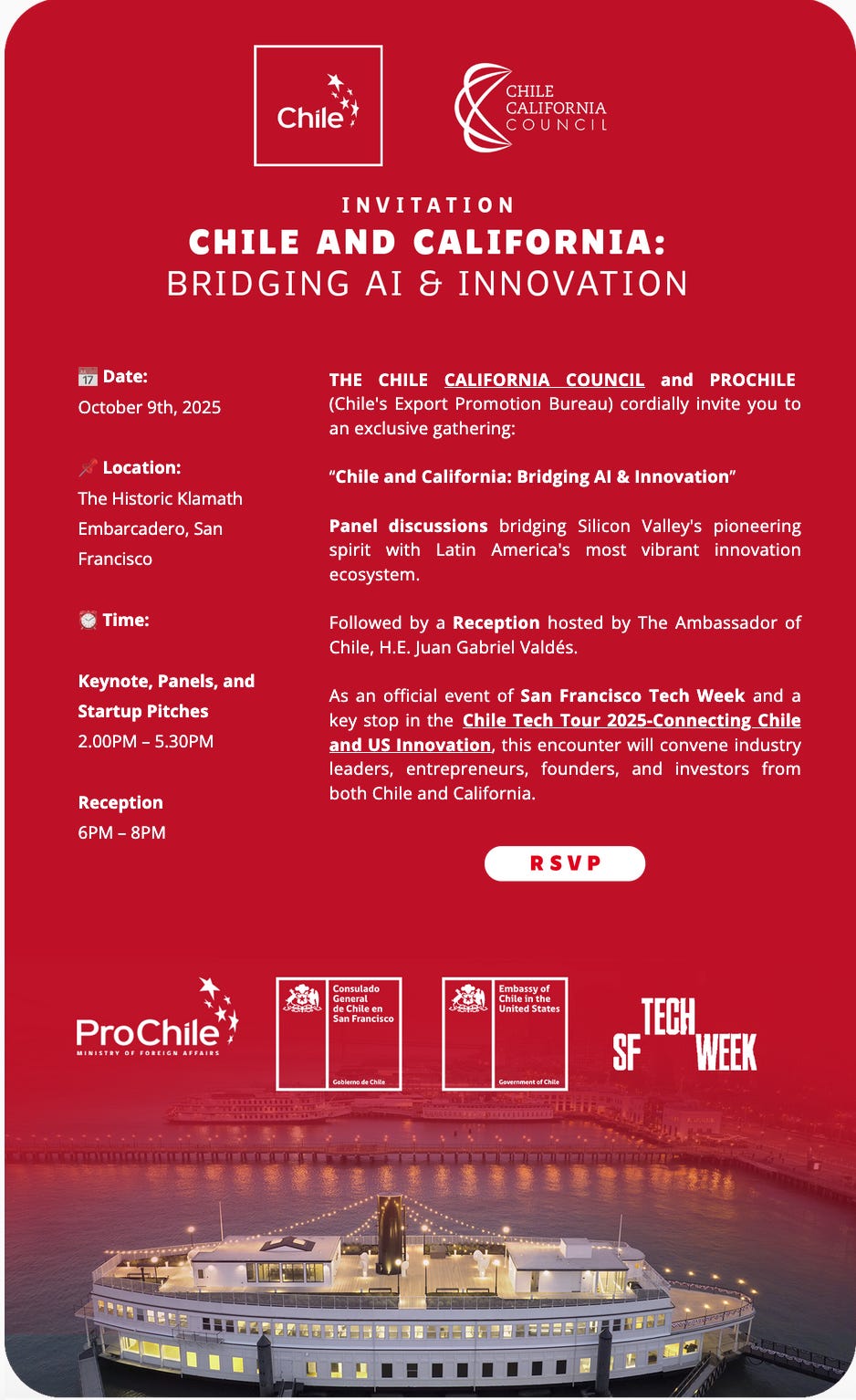
Chile and California: Bridging AI and Innovation. As many of you know, I serve as Co-Chair of the Chile California Council. On October 9th, we’re co-hosting an event at the Historic Klamath on AI and innovation. If you’re in the San Francisco Bay Area and interested in this topic, I’d encourage you to sign up!
Onward and upward.
Sincerely,
Evan Epstein